Total Dissolved Solids (TDS) is one of the most commonly discussed measurements in swimming pool water chemistry. Pool professionals often use TDS readings to evaluate water quality, identify dissolved material buildup, and determine when water replacement may be necessary.
However, a high TDS reading does not automatically mean that swimming pool water is dirty, unhealthy, or unsuitable for use. Understanding what contributes to TDS and how different dissolved substances affect water chemistry is essential for proper pool maintenance.
In this guide, we explain what TDS means, how it is measured, why different substances produce different readings, and when high TDS levels may indicate a problem.
What Is TDS in Swimming Pool Water?
Total Dissolved Solids (TDS) refers to the dissolved substances present in water. These substances may include:
- Sodium and chloride salts
- Calcium and magnesium minerals
- Bicarbonates and sulfates
- Dissolved chemical treatment by-products
- Nitrates and phosphates
- Other dissolved organic and inorganic materials
TDS is commonly expressed in milligrams per litre (mg/L) or parts per million (ppm). For water, these units are approximately equivalent.
As pool water circulates and receives chemical treatments, dissolved substances can gradually accumulate. Evaporation can also increase their concentration because water evaporates while most dissolved salts remain behind.
How Is TDS Measured in Pool Water?
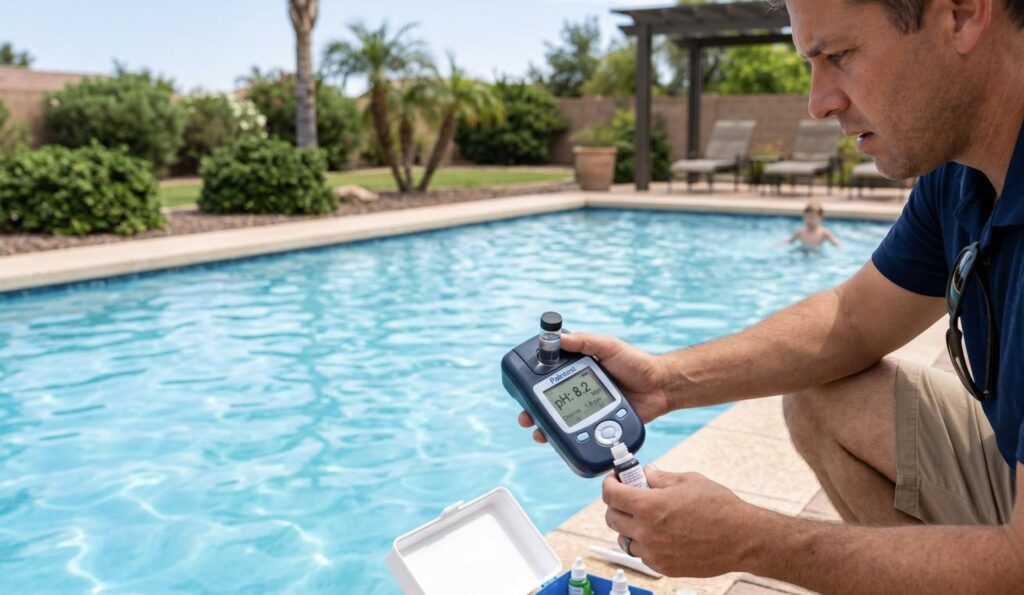
Most handheld TDS meters do not directly measure the total mass of dissolved substances.
Instead, they measure Electrical Conductivity (EC), which indicates how easily electrical current passes through water. The meter then uses a conversion factor to estimate TDS.
Water containing dissolved salts generally conducts electricity because salts separate into positively and negatively charged ions.
Different meters may use different conversion factors, which means two instruments can display different TDS values for the same water sample.
This is why TDS readings should be interpreted carefully rather than treated as an exact measurement of every dissolved substance in the pool.
Why Do Some Dissolved Substances Increase TDS Readings More Than Others?
Not all dissolved materials affect electrical conductivity in the same way.
For example, consider two separate containers filled with one litre of deionized water.
- Container A contains 10 grams of table salt.
- Container B contains 10 grams of sugar.
Both containers contain the same mass of added material. However, their conductivity readings will be significantly different.
1. How Salt Affects TDS
When sodium chloride (NaCl) dissolves in water, it separates into two charged ions:
- Sodium (Na⁺)
- Chloride (Cl⁻)
These ions move freely through the water and allow electrical current to pass more easily.
As a result, salt significantly increases electrical conductivity and produces a higher estimated TDS reading.
2. Why Sugar Has a Different Effect
Sugar dissolves in water but generally remains in the form of electrically neutral molecules.
Unlike salt, it does not separate into charged ions under normal water conditions.
Consequently, sugar can contribute to the actual dissolved material in water without producing a comparable increase in conductivity.
Key takeaway: A TDS meter primarily responds to dissolved ions that contribute to electrical conductivity. It does not provide a complete picture of every dissolved substance present in swimming pool water.
What Causes High TDS Levels in Swimming Pools?
Several factors can contribute to increasing TDS levels over time.
1. Swimming Pool Chemicals
Regular chemical treatments introduce dissolved substances into pool water. Depending on the products used, these substances can contribute to increasing conductivity and TDS readings.
2. Water Evaporation
When water evaporates, dissolved minerals and salts generally remain behind. As a result, their concentration increases.
This is particularly relevant in warmer climates where evaporation rates can be relatively high.
3. Source Water Quality
The mineral composition of the original water supply can significantly influence the initial TDS level.
Groundwater, municipal water, and other water sources may contain different concentrations of sodium, chloride, calcium, bicarbonates, and other dissolved substances.
4. Organic Contamination
Leaves, dust, debris, body oils, and other contaminants can introduce additional materials into swimming pool water.
Some contamination sources may also contribute nutrients that encourage algae growth.
Does High TDS Make Swimming Pool Water Green?
High TDS alone does not necessarily cause green swimming pool water.
Green water is commonly associated with algae growth, which may be encouraged by factors such as:
- Insufficient free chlorine
- Poor water circulation
- Inadequate filtration
- Elevated phosphate levels
- Nitrate contamination
- Unbalanced pool water chemistry
TDS may increase alongside these problems, but this does not mean that TDS itself is directly responsible for algae growth.
For example, two swimming pools can have identical TDS readings while showing completely different water conditions.
One pool may contain mostly dissolved salts and remain clear, while another may contain unwanted nutrients and experience algae problems.
The difference lies in the chemical composition of the water.
Why a TDS Reading Alone Cannot Determine Pool Water Quality
Relying exclusively on TDS measurements can lead to incorrect conclusions about swimming pool maintenance.
A TDS meter cannot identify exactly which substances are dissolved in the water.
For a more complete understanding of pool water quality, professionals should also evaluate:
- Free Chlorine: Measures the chlorine available for sanitation.
- pH Level: Indicates whether the water is acidic or alkaline.
- Total Alkalinity: Helps maintain stable pH levels.
- Calcium Hardness: Measures dissolved calcium and helps assess scaling and water balance.
- Cyanuric Acid (CYA): Helps stabilize chlorine in outdoor pools.
- Phosphates: Can provide nutrients that support algae growth.
- Electrical Conductivity: Helps monitor the concentration of conductive dissolved substances.
Combining these measurements provides a more useful picture of overall pool water chemistry.
When Should Swimming Pool Water Be Replaced?
Water replacement may be necessary when dissolved substances accumulate to levels that create operational or water-balance problems.
However, the decision should not be based on a single TDS threshold.
Pool professionals should consider:
- The original TDS level of the source water.
- The current TDS reading and its historical trend.
- The types of chemicals used for pool treatment.
- Calcium hardness and overall water balance.
- Chloride and other dissolved ion concentrations.
- Whether the pool is experiencing persistent water-quality problems.
Partial water replacement or dilution with suitable fresh water may help reduce excessive dissolved material concentrations.
The appropriate approach depends on the pool’s water chemistry, sanitation system, and applicable industry standards.
Saltwater swimming pools are a good example of why TDS must be interpreted in context. These systems intentionally maintain elevated salt concentrations, so a high TDS reading is expected and does not automatically indicate poor water quality.
Best Practices for Managing TDS in Swimming Pools
Maintaining suitable water chemistry requires more than monitoring a single measurement.
Consider these practical maintenance recommendations:
- Test pool water regularly using properly calibrated equipment.
- Monitor TDS trends rather than relying on isolated readings.
- Check free chlorine and pH levels consistently.
- Maintain appropriate filtration and circulation.
- Remove leaves, debris, and other contaminants.
- Monitor calcium hardness and total alkalinity.
- Evaluate source water before filling or refilling a pool.
- Investigate unusual TDS increases through additional water testing.
Consistent monitoring helps identify potential water-quality issues before they become more difficult to manage.
Final Thoughts: Understanding the Meaning Behind TDS
Total Dissolved Solids is a useful measurement in swimming pool water chemistry, but it should never be treated as a standalone indicator of water quality.
A high TDS reading may indicate accumulated salts, chemical residues, minerals, or other dissolved substances. However, the actual impact depends on what those substances are and how they interact with the pool’s water chemistry.
The most effective pool maintenance approach combines TDS monitoring with proper testing of chlorine, pH, alkalinity, calcium hardness, and other relevant water-quality parameters.
Instead of asking only how high the TDS reading is, pool professionals should also ask what is contributing to that reading.
Understanding the composition of swimming pool water leads to better maintenance decisions, more effective chemical treatment, and healthier pool operation.
Frequently Asked Questions (FAQs)
1. What does TDS stand for in swimming pools?
TDS stands for Total Dissolved Solids. It represents dissolved substances in water, including salts, minerals, and other materials.
2. What is a good TDS level for swimming pool water?
There is no single universal TDS value that determines whether every swimming pool is healthy. Appropriate levels depend on source water, pool type, treatment chemicals, and applicable water-quality guidelines.
3. Does high TDS affect chlorine effectiveness?
High TDS alone does not necessarily reduce chlorine effectiveness. However, certain dissolved substances and overall water chemistry conditions can influence sanitation performance.
4. Can high TDS cause green pool water?
Not directly. Green pool water is generally associated with algae growth, which can result from inadequate sanitation, poor circulation, and the presence of nutrients such as phosphates.
5. How often should TDS be tested in a swimming pool?
Testing frequency depends on pool usage, water treatment practices, and maintenance requirements. Regular monitoring helps identify unusual increases and changes in water chemistry.
6. Does adding fresh water reduce TDS?
Yes. Replacing some pool water with suitable fresh water can dilute dissolved substances and lower the overall TDS concentration.
7. Why do different TDS meters show different readings?
Different meters may use different electrical conductivity conversion factors. Calibration, temperature compensation, and instrument settings can also affect the displayed readings.
8. Is high TDS normal in saltwater swimming pools?
Yes. Saltwater pools intentionally contain dissolved salt to operate their chlorine-generation systems. Therefore, their TDS readings are naturally higher than those of many conventional pools.
Suggested Image Alt Text: TDS testing meter measuring total dissolved solids in swimming pool water.
Related Topics: Swimming Pool Water Chemistry, Pool Maintenance, Electrical Conductivity, Water Quality Testing, Pool Chemical Balance.